
This topic covers work on crime and security futures: also referred to as anticipation, foresight or horizon-scanning.
The experience on which the futures material is based derives from work with the UK government Foresight Programme (scroll down Foresight Programme page to Crime Prevention; and see also later Foresight Programme work on Cyber Trust and Crime Prevention and Intelligent Infrastructure Futures). A strong lead on crime and security futures work is now supplied by the Dawes Centre for Future Crime at UCL.
On this page are sections on:
- The importance and nature of crime and security futures work
- The application of Crime Frameworks to futures work – principally, the Misdeeds and Security, Conjunction of Criminal Opportunity and 5Is Frameworks
- Evolutionary approaches to crime and security
- Listings of publications and presentations
Other crime and security futures pages cover topics in depth:
- Detection, anticipation and response – a sequence of levels of orientation towards the future, ranging from simple to sophisticated
- Crime Impact/ Risk Assessment and Crime Proofing – basic future-oriented activities
- The Misdeeds and Security Framework – systematically spotting emergent opportunities for offending, and for preventing/reacting to crime
- Application of Crime Science theories and perspectives to futures work
- Vehicle crime futures and climate change, crime and security
Other future-oriented topics are covered under Innovation and Arms races. There are also connections with Security and Risk Management, and Resilience.
The importance and nature of crime and security futures work
Crime, disorder and terrorism are always changing (see also Evolution, crime and security). Offenders adapt to crime prevention methods, rendering what is currently successful, obsolete. New products and services, new business models, and wider social and economic change, mean that, for example:
- The Internet markets the products etc and disseminates the know-how behind them
- New targets for crime emerge – e.g. smartphones
- New environments for crime emerge, like cash machines
- New niches for crime promoters emerge – e.g. re-chipping stolen mobiles
- New patterns of socialisation create, or have the potential to reduce, risk and protective factors for criminality
- New living conditions and life circumstances create new motivation to offend, and new conflicts
- New tools and information become available for offenders to use, e.g. the extensive misuse and misbehaviour that has emerged with drones. Or a humbler example, the adaptive ‘Gator grip’ universal socket wrench, which at a stroke renders obsolete those crime resistant fittings that were anchored by unusually-shaped bolts, and greatly reduces the toolkit that thieves may need to carry

The security response to these problems often lags well behind. Being alert to emerging patterns and methods of crime, and responding in a timely and adaptive way are vital. Anticipation can help us keep up better, or occasionally even get ahead of the game. Detecting, anticipating and responding to new crime problems are covered here.
Anticipation can take several forms:
- Simplest are three risk-focused activities. Crime Impact Assessments ask what crime risks might be generated by this new product, building, regulation or service? Crime Risk Assessments ask what are the likely future incoming crime risks to this location, this new product or this activity? And Crime Proofing of designs and potential services asks how do we ensure these have inbuilt security commensurate with the crime risks and impacts they might be expected to generate? These activities are covered here.
- More advanced are Horizon-Scanning/ Foresight activities. These take a wider view of future possibilities, considering how changes in a range of domains may affect crime, and vice-versa, using diverse approaches and techniques, such as scenario-building; and coming up with suitable response plans for coping with undesirable future trends and events, or creating desired ones. Typically, the domains addressed are political, economic, social, health-related, technological, environmental, legal, organisational, media-related and infrastructural (‘PESHTELOMI’). Changes can be considered over different timescales. Crimes covered can range from general (e.g. violence) to specific (e.g. vehicle crime); and the analysis can be one-way or bi-directional (e.g. effects of climate change on crime, and crime on climate change).
Anticipation of all kinds is challenging. Rather than being a straightforward projection of current trends, the future is full of surprises from nonlinearities. A classic example is the sudden theft of telephone box handsets on the island of Bali – but only on the coast. Apparently, local people discovered that if you wired these to a battery, sealed them in a plastic bag and lowered them into the sea, the screaming noise was good for attracting fish. Whoever could have predicted, and designed against, that?
It is therefore easy to get anticipations wrong:
- Military history is full of examples of armies ‘fighting the previous war’.
- A UK Home Office panel active 2002-4 to review new technological threats and opportunities (described in Ekblom 2004d) dismissed drones as an issue, on the grounds that Unmanned Aerial Vehicles would never be licensed in the UK.
- When TV broadcasts first went digital, special ‘set-top boxes’ were marketed to enable older TVs to decode the signals. These were viewed as likely ‘Hot Products’, at elevated risk of theft, on the grounds that they would be available in most households, easily removable, valuable, enjoyable and/or disposable. They were valid risk factors, until the TV service providers decided to give them away for free and recoup the money on rental charges. Fortunately, inertia had meant that no wasteful action had been taken to get the manufacturers to boost the security on the boxes.
Beyond the technical side of anticipation, come the policy and political aspects of what futures are desirable/ undesirable, how to make a convincing case for advance action, and what that action should be.

The application of the Crime Frameworks to crime and security futures work
All the Crime Frameworks can be applied in support of a futures perspective, as can Crime Science more generally, covered here. But three frameworks deserve special mention: Misdeeds and Security, the Conjunction of Criminal Opportunity and the 5Is. Evolutionary approaches to crime and security are also relevant.
Using the Misdeeds and Security Framework
The Misdeeds and Security Framework considers a given innovation or other technological or social change and asks what offenders, and security designers, might make of it in pursuing their respective goals – affordance.
Although the framework originated in a futures context, where it can contribute to systematic Crime Impact/Risk Assessments and Crime Proofing, it has wider uses. It enables users to compress and simplify the huge and ever-proliferating array of criminal offences and ‘offence elements’ into a manageable, limited and structured set of ‘Misdeeds’. It lists some very generic elements of criminal behaviour, and then identifies equally generic security actions to counter them.
The Misdeeds and Security Framework is set out in detail here.
Using the Conjunction of Criminal Opportunity Framework
The Conjunction of Criminal Opportunity Framework, with its sharp and systematic focus, features in many of the futures approaches within Crime Frameworks.
An early attempt to apply the CCO was entitled Future Imperfect – with the classic example of the unforeseen crime consequences of the introduction of the wheelie bin.
A more recent application of the CCO Framework is embedded in this broad look at future crime (Johnson et al. 2018).
Using the 5Is Framework
Future changes can also influence the process of undertaking crime prevention, security and community safety. The 5Is Framework depicts this process in terms of five task streams – Intelligence, Intervention, Implementation, Involvement and Impact. For example, changes in the regulatory environment of the police can influence what Intelligence they can collect on crime problems, and how they can use it. Or changes in the trust environment may affect cooperation from the public.
Using the Conjunction of Criminal Opportunity, and Misdeeds and Security Frameworks together
In horizon-scanning, one way of forecasting the future is to rely on causal models derived, ideally, from tested theoretical mechanisms, and/or broader causal principles. We can thus use the full set of causal factors identified within Crime Science, to envisage how changes in these can change the frequency, distribution or nature of criminal events. And we can go on to consider the ’causes of the causes’. For example, how can future changes in PESHTELOMI domains affect criminals’ readiness to offend or the availability of resources for offending such as tools or weapons?
Drones can be used as an example to show how the CCO and Misdeeds and Security Frameworks can be applied to futures work.

Using the Conjunction of Criminal Opportunity Framework, we can anticipate drones as targets, tools, weapons and preventer aids.
Drones can be viewed in terms of affordance. Applying the Misdeeds and Security along with the CCO Frameworks we can ask, e.g., ‘How can drones be misappropriated or mistreated (as targets), misused or misbehaved with (as tools or weapons)?’
We can also ask the related question: What is the functional essence of drones for criminals and for security? An answer is ‘Drones supply active, mobile and agile, cost-effective, telepresence of human agency connected for real-time sensing, perception and action (including carriage) in places and dimensions where humans cannot safely or conveniently go.‘ (Ekblom 2022) .
Using the CCO and 5Is Frameworks together
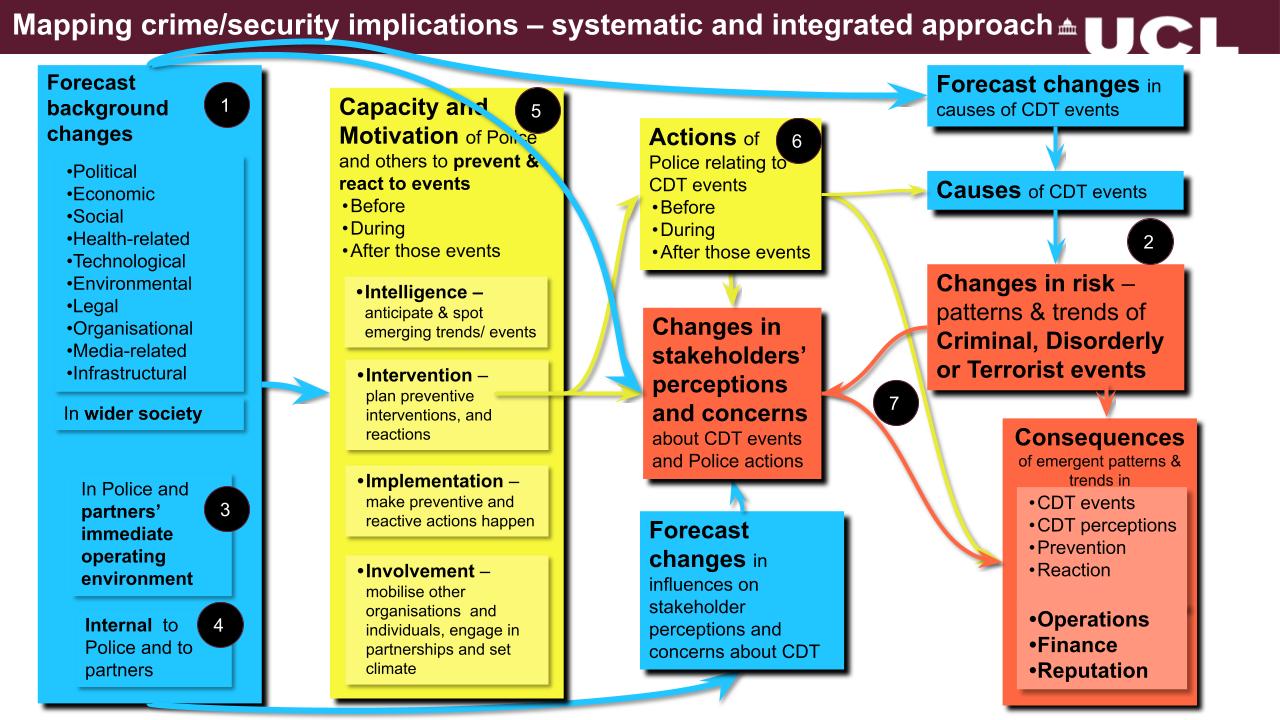
The following diagram (from this presentation) maps out various connections between 1) forecast background changes in society; 2) changes in the causes, risks and consequences of crime, disorder and terrorism (CDT) events (using the Conjunction of Criminal Opportunity Framework); 3) changes in the immediate operating environment of the police and other security partners; and 4) changes internal to their organisations, which influence 5) their capacity and motivation to deal with crime (using the 5Is Framework). In turn these changes affect 6) the actions of police and security partners, and, as a result, 7) crime perceptions, concerns, risks and consequences.
Evolutionary approaches to crime and security
Although not explicitly addressing crime and security futures, evolutionary approaches to crime and security are intended to help anticipate future crimes and prepare appropriate responses. They focus on developing the evolutionary capacity to ‘gear up against crime’ and out-innovate adaptive offenders in the arms race, against a background of technological, social and other changes which may favour one side or the other, in what can sometimes be a disruptive breakthrough.
Publications and presentations on crime and security futures
The articles and presentations listed on this page show how other approaches and frameworks can contribute to undertaking foresight in a way that combines rigour with structured, cross-disciplinary speculation; and how they can suggest new perspectives.
Publications
Ekblom, P. (2022). ‘Facing the future: the role of horizon-scanning in helping security keep up with the changes to come’ in M. Gill (Ed.) The Handbook of Security 3rd Edn. Basingstoke: Palgrave MacMillan.
A tour d’horizon of horizon scanning approaches for the Handbook of Security
Johnson, S., Ekblom, P., Laycock, G., Frith, M., Sombatruang, N. and Rosas Valdez, E. (2019). ‘Future crime’ in R. Wortley, A. Sidebottom, N. Tilley and G. Laycock (Eds.), Routledge Handbook of Crime Science 428-446. Milton Park: Routledge.
An overview of approaches to future crime in the Routledge Handbook of Crime Science.
Intelligent infrastructure (2006).
A UK government Foresight project looking forward to 2050. Crime vignettes for the various scenarios are on pp.18-23.
Ekblom, P. (2004d). ‘How to Police the Future: Scanning for Scientific and Technological Innovations which Generate Potential Threats and Opportunities in Crime, Policing and Crime Reduction’, in M. Smith and N. Tilley (Eds.), Crime Science: New Approaches to Preventing and Detecting Crime. Cullompton: Willan.
Describes the work of an early UK Home Office/Police horizon scanning group and introduces the Misdeeds and Security Framework.
Ekblom, P (2002a). ‘Future Imperfect: Preparing for the Crimes to Come.’ Criminal Justice Matters 46 Winter 2001/02: 38-40. London: Centre for Crime and Justice Studies, Kings College.
An early attempt to illustrate the application of the Conjunction of Criminal Opportunity Framework to horizon-scanning. The CCO further features at various points in the UK Foresight Programme’s Cyber Trust and Crime Prevention project, e.g. in the science synthesis.
Ekblom, P. (2000b). Future Crime Prevention – a ‘Mindset Kit’ for the Seriously Foresighted. UK Foresight Programme project on Crime Prevention. Open ‘Crime Prevention’.
A briefing for the UK Foresight Programme’s Crime Prevention Panel.
Presentations
Full generic presentation to University of Sydney/Australian Institute of Criminology:
Lectures to the UCL Dawes Centre Crime Science masters module on horizon scanning 2020:
 CRIME FRAMEWORKS