
The Crime Role Grid supports a system-level view of all the agents/players in complex or organised crimes. It can be used to plan interventions that, in principle, have a greater chance of success, and lesser chance of backfiring.
The grid is relevant to Intelligence, Intervention, Implementation and Involvement task streams under the 5Is Framework; and the Offender, Preventer and Promoter roles within the Conjunction of Criminal Opportunity Framework. It was developed for a project on fly tipping/ illegal waste dumping.
A predecessor grid, which maps out legitimate and illegitimate art and enforcement roles for graffiti, is also shown below.
We are often faced with a complex adaptive system (see here and for a more practical view from health science, here), in which multiple agents interact with one another, and adapt over time in reaction or anticipation, leading to unforeseen and often undesirable consequences.
The Crime Role Grid is a framework to help analyse, and deal with, the diverse sets of agents involved in any complex crime, as a system – whether as offenders, preventers, promoters or victims.
The Grid can be used in combination with dependency maps, such as this from Europol which depicts how diverse criminal players support/depend on one another in cybercrime enterprises. Such maps could also be used for material crimes.
The Grid is based on work for a 2021 project on illegal fly-tipping (waste dumping). It cross-tabulates crime roles derived largely from the Conjunction of Criminal Opportunity Framework (Offender, Preventer, Promoter; but also Victim, Responder, Enforcer, Regulator, Legislator…) with civil roles (e.g. waste producer, waste holder, waste carrier, waste processor, advertising platform). A waste holder for example can be an offender, promoter or victim.
Having identified particular role combinations, then professional preventers, responders or enforcers can map out the actors’ goals, resources, attitudes, scripts etc in order to plan interventions that will not fail or backfire.
The Grid relates to involvement in the 5Is Framework, and could usefully be connected to the supercontroller concept described by Sampson et al (2010).
This presentation introduces the Grid:
The slide below, from the presentation, shows a section of the Crime Role Grid applied to waste dumping. The horizontal axis sets out a range of generic crime roles starting with those in the Conjunction of Criminal Opportunity Framework and continuing, beyond the columns shown in the slide, to include additional roles such as responder, victim, regulator and legislator. The vertical axis lists the particular civil roles relevant to waste production, handling, carrying and disposal. Again there are further civil roles in rows not shown here. The cells depict specific combinations of crime x civil roles which are known to exist or at least are plausible.
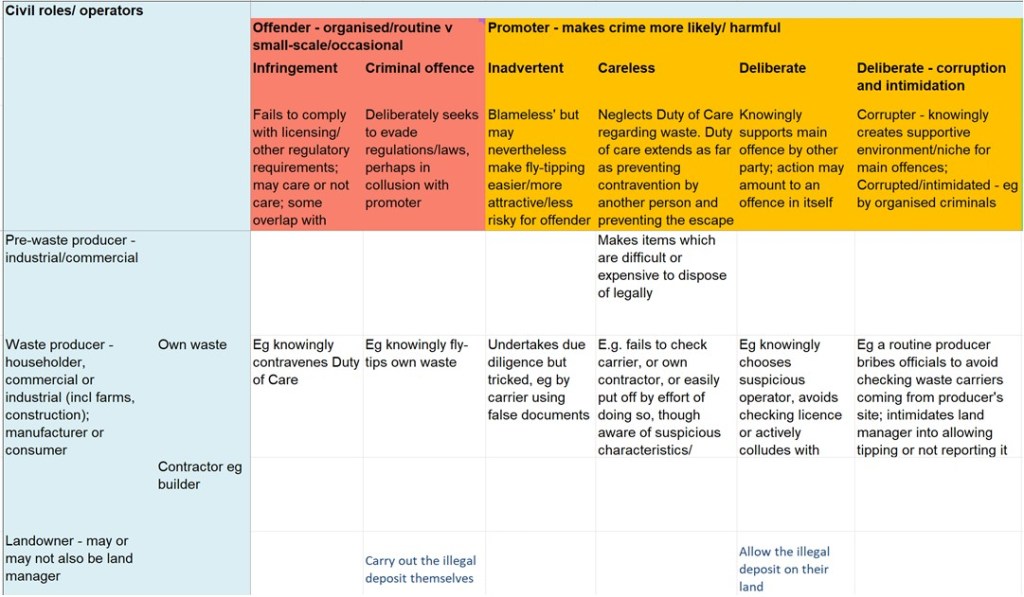
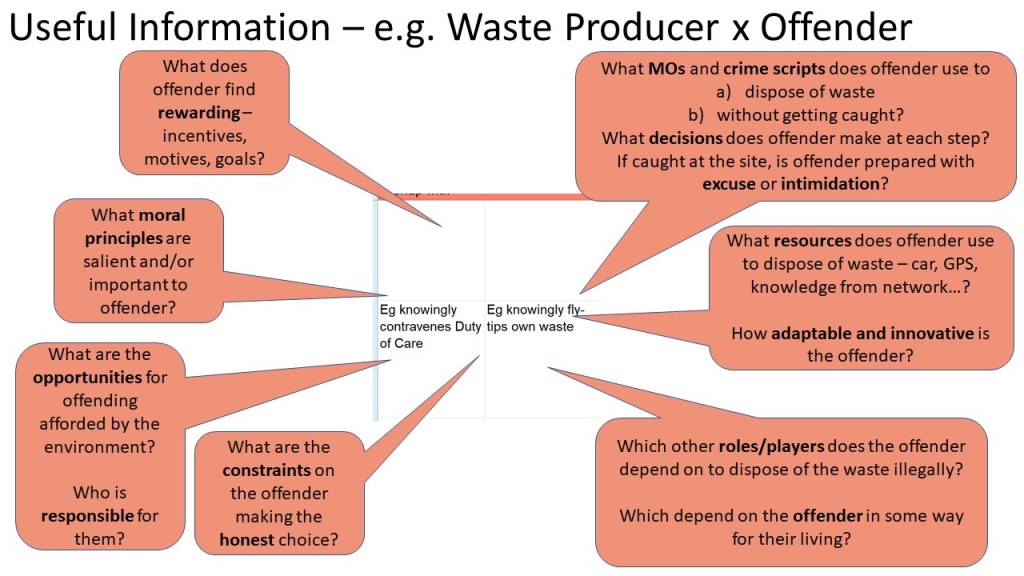
The slide below focuses on a single one of the above cells – the civil role of waste producer, x the crime role of offender. It poses various questions: the answers to these could guide practitioners planning interventions that intelligently target the crime, whilst avoiding undesired side effects and counterproductive ‘backfires’.

Graffiti – crime, civil and legitimate art roles
A less-developed example of the Crime Role Grid was previously undertaken in project Graffolution, an EU study on the control of graffiti.
Like the Vibrant-Secure Function Framework, it addresses criminal/ undesirable behaviour in a design context of ‘what we want more of’ alongside ‘what we want less of’. The various role combinations are each given codes to identify them when characterising the action in a uniform way across diverse case studies.
A working document mapped out crime roles – where people were putting up images in the ‘wrong’ places – against civil roles and art roles – where people were producing legal artworks in ‘appropriate’ places:
 CRIME FRAMEWORKS